




Artificial Intelligence never sleeps and is rapidly transforming how hackers operate.
AI helps companies analyse data, automate repetitive tasks, improve customer service, and make faster decisions. Across Indiana and the United States, organisations of every size are discovering new ways to improve efficiency and reduce costs using AI-powered tools.
Unfortunately, every major technological advancement eventually attracts people looking to exploit it.
The internet revolutionised communication and commerce but also created new opportunities for fraud. Email transformed business productivity but opened the door to spam, phishing, and identity theft. Artificial intelligence is following a similar path. Used responsibly, it can be a powerful business asset. In the hands of cybercriminals, it becomes something very different: a force multiplier capable of increasing the speed, scale, and sophistication of cyberattacks.
Not long ago, conducting a serious cyberattack required significant technical expertise and a great deal of time. Criminals had to manually identify targets, research organisations, gather information, and carefully craft scams designed to deceive employees. Today, AI is dramatically reducing those barriers.
Automated AI agents can continuously scan the internet for vulnerable websites, outdated software, exposed remote access services, leaked credentials, and poorly secured Microsoft 365 environments. While the attacker sleeps, AI-powered systems can gather intelligence, profile organisations, identify key personnel, and generate highly convincing phishing campaigns. Tasks that once required an organised group of cybercriminals can increasingly be managed by a single individual equipped with the right tools.
Cybercrime has not become effortless, but it has become faster, cheaper, and far easier to scale. For a relatively small investment, an attacker can automate activities that would have required hundreds of hours of manual effort only a few years ago.
This matters because many small and mid-sized businesses still believe they are unlikely targets. That assumption is becoming increasingly dangerous.
Today’s attackers are not necessarily choosing victims based on size, reputation, or revenue. Automated AI systems are searching for weaknesses. They are looking for businesses with outdated systems, weak passwords, unprotected accounts, insecure remote access, or gaps in their cybersecurity practices.
A manufacturing company in Kokomo, a professional services firm in Noblesville, a medical office in Cicero, or a local business in Tipton may all appear equally attractive if they share the same vulnerabilities.
To automated attack systems, every connected business is simply another opportunity waiting to be evaluated.
The evolution of phishing attacks provides a clear example of this shift. The obvious scam emails filled with spelling mistakes and awkward wording are gradually disappearing. Modern AI tools can analyse company websites, LinkedIn profiles, social media accounts, press releases, and publicly available information in seconds. They can learn the names of employees, identify vendors and business partners, understand industry-specific terminology, and generate messages that appear completely legitimate.
A fraudulent email may reference an actual customer, a current project, a recent purchase order, or a real supplier relationship. The result is a level of personalisation that would have been difficult and time-consuming to achieve in the past.
For business owners, there is another unsettling reality: AI does not simply help criminals launch attacks; it helps them prioritise targets.
Many cybercriminals are no longer spending their time searching manually; their bots are doing it for them, 24 hours a day, 7 days a week.
Automated systems can process enormous amounts of information and quickly identify organisations that appear easier to compromise. Businesses that fall behind on software updates, fail to enforce multi-factor authentication, reuse passwords, or neglect employee security awareness training may stand out immediately.
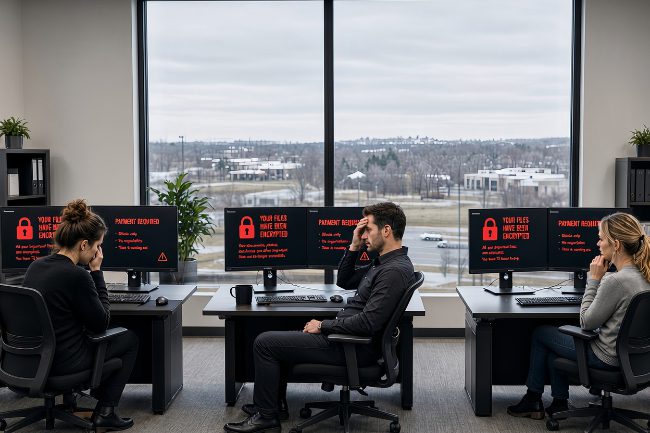
When an attack succeeds, the consequences often extend far beyond the initial security incident. The financial impact can include operational downtime, lost revenue, disrupted customer service, emergency IT recovery expenses, legal costs, compliance requirements, and reputation damage.
Employees may be unable to access critical systems. Orders may be delayed. Customer communications may stop. Accounting systems may become unavailable. Productivity can decline sharply as teams struggle to restore operations.
For many organisations, the resulting business interruption creates more damage than the ransomware demand itself.
If customer information, employee records, financial data, or other sensitive information is compromised, businesses may also face regulatory obligations, legal exposure, and increased scrutiny from clients and partners. Recovery often requires specialised cybersecurity expertise, significant management time, and difficult decisions made under pressure.
Artificial intelligence is amplifying these risks because it can assist in analysing software, identifying vulnerabilities, generating malicious code, and automating portions of the attack process. It is not an all-knowing digital mastermind, and it still makes mistakes, but its capabilities continue to improve at a remarkable pace.
The good news is that defenders are using the same technology.
Modern cybersecurity platforms leverage AI to identify suspicious behaviour, detect account compromise, monitor endpoints, reduce response times, and improve threat visibility. Security solutions from Microsoft, Cisco, CrowdStrike, Huntress, and others increasingly rely on machine learning and automation to help organisations identify risks before they become major incidents.
The cybersecurity battle is no longer simply humans versus hackers; it is organisations using intelligent defensive technologies against criminals using intelligent offensive technologies.
The practical lesson is straightforward – an annual technology review is no longer enough.
New vulnerabilities emerge every week. Employees change roles. Passwords are compromised. Software updates are released. Backup systems fail. Criminals continue scanning for weaknesses around the clock.
Businesses do not necessarily need a large enterprise security team, but they do need a proactive approach to cybersecurity. That includes regular patch management, strong password policies, multi-factor authentication, endpoint protection, Microsoft 365 security controls, employee awareness training, and backup systems that are tested regularly rather than simply assumed to work.
Cybersecurity is no longer a concern for only large corporations; it has become a fundamental business requirement for organisations of every size.
The real change AI has introduced… Cybercrime no longer needs to be personal, patient, or particularly selective.
The cybercriminal of the future may not be a highly skilled hacker sitting in front of multiple monitors in a hidden location. The cybercriminal may be an ordinary individual asleep at home while automated AI agents examine thousands of businesses across the country, searching for the forgotten software update, exposed account, vulnerable website, or reused password that opens the door.

Somewhere tonight, an AI system may be testing your website, examining your Microsoft 365 environment, scanning for vulnerabilities, monitoring exposed services, or evaluating whether your business is an easy target. These systems work continuously, without breaks, weekends, or holidays. The main question is not whether cybercriminals are using AI to look for weaknesses, because they already are. The main question is whether your business is properly protected or wide open to attack.
At Magnify247, our goal is simple: help Central Indiana businesses stay productive, secure, and protected through reliable remote IT support and services, proactive maintenance, secure backups, and practical cybersecurity guidance.